user@devops:~$ cat README.md
AutoML Showdown
# Description
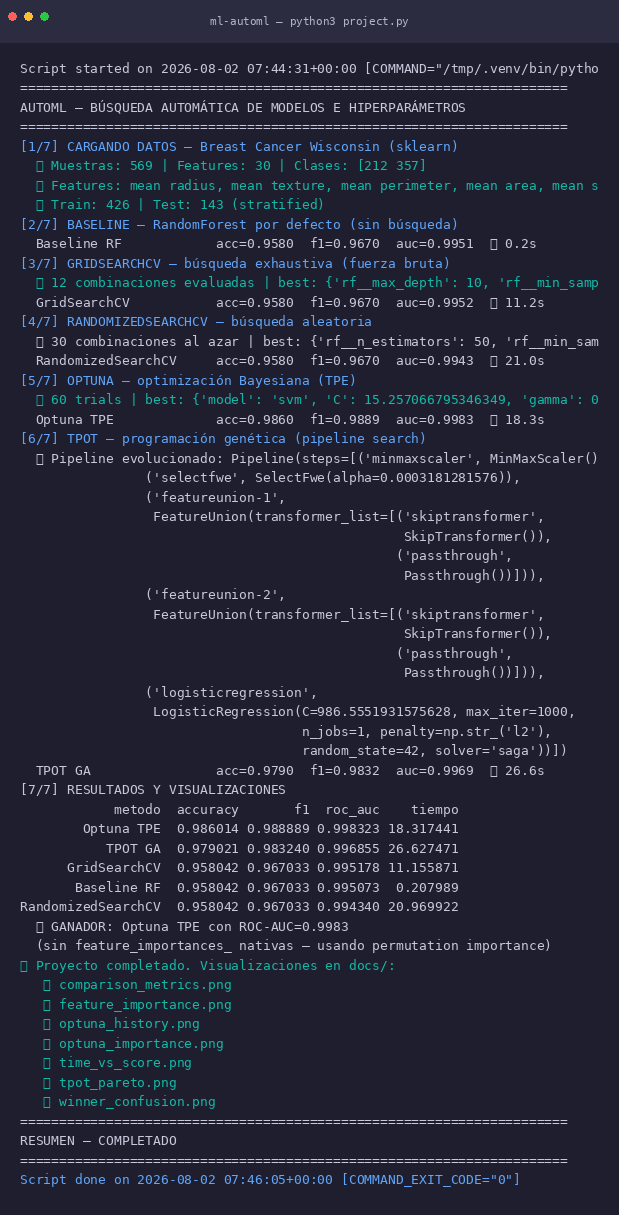
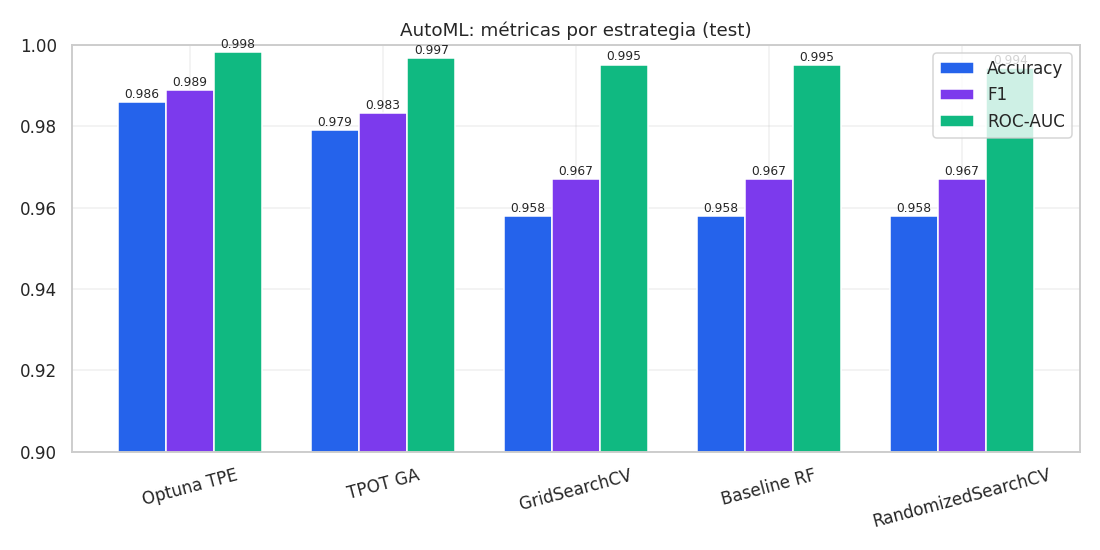
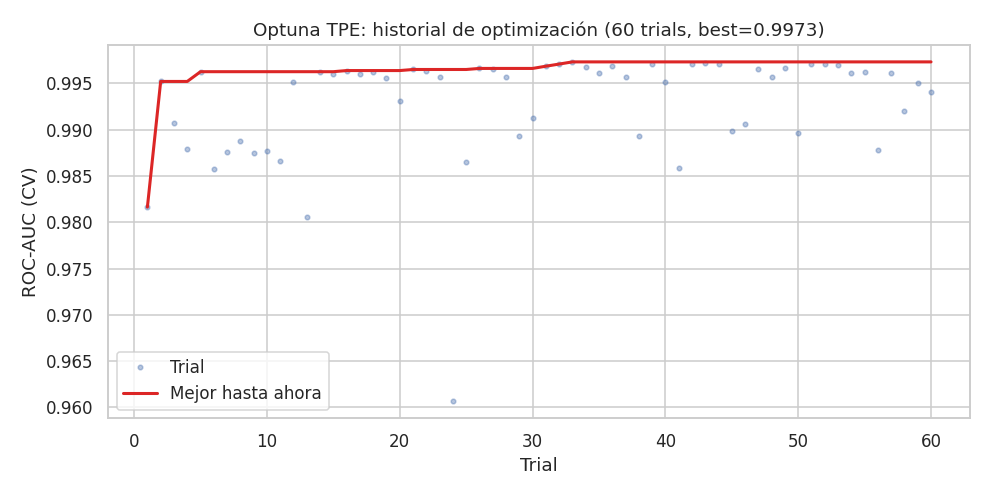
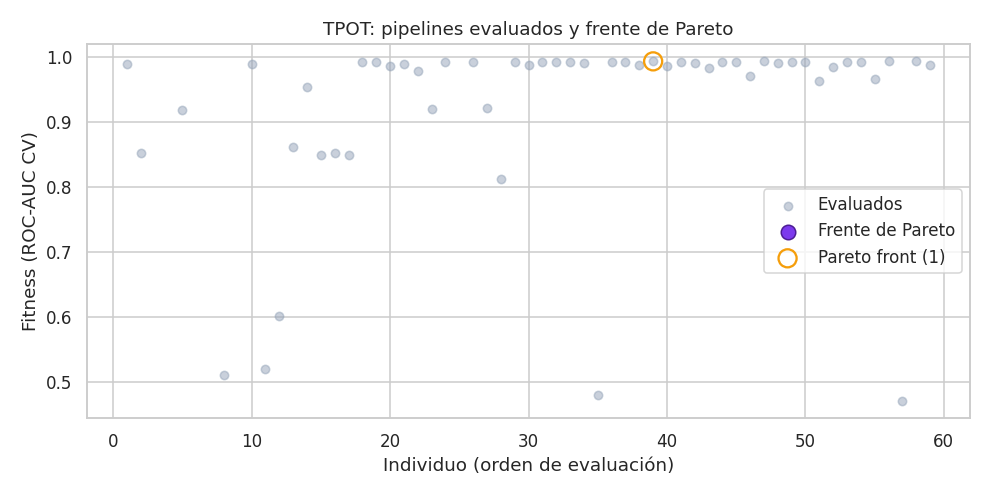
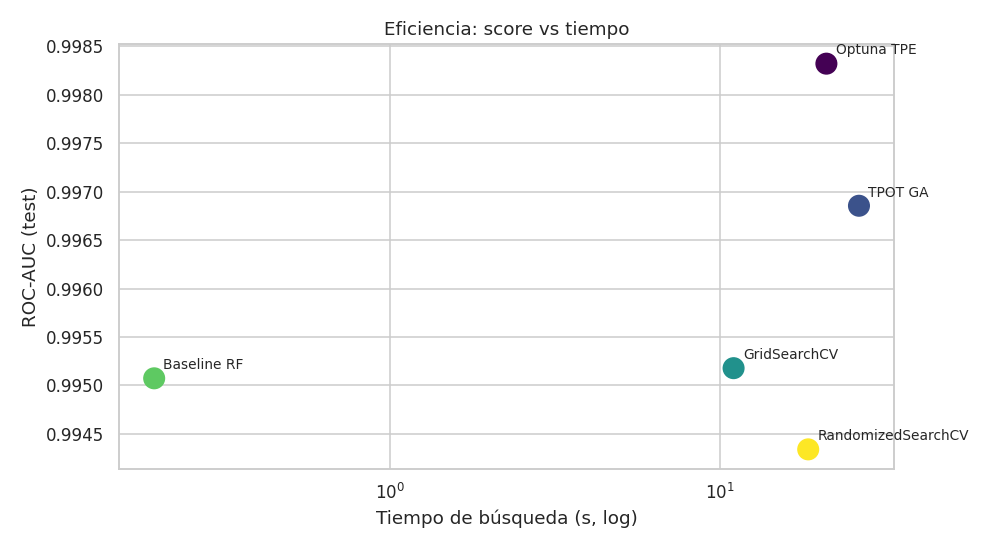
AutoML (Automated Machine Learning) compared in practice: 5 strategies compete to find the best classifier for Breast Cancer Wisconsin (569 samples, 30 features) with no manual intervention. Strategies: (1) Baseline — default RandomForest; (2) GridSearchCV — evaluates all 12 combinations of a grid; (3) RandomizedSearchCV — 30 random samples from a 360-combination space; (4) Optuna TPE — 60 Bayesian optimization trials that also pick among 4 algorithms (RF, GradientBoosting, LogisticRegression, SVM); (5) TPOT — genetic programming that evolves full pipelines (scaler + selector + classifier) with crossover and mutation. Test results: Optuna TPE wins with ROC-AUC 0.9983 (acc 0.986, F1 0.989) in just 18.7s of search; TPOT reaches 0.9969 by evolving non-obvious pipelines (e.g. L1 LogisticRegression with SelectPercentile); GridSearch (0.9952) and Baseline (0.9951) tie on accuracy but at 60x more manual effort. Key findings: (1) Bayesian search leverages previous trials and beats brute force with fewer evaluations; (2) TPOT discovers pipelines a human would never try; (3) Optuna's hyperparameter importance reveals which levers truly move the score (SVM C and gamma dominate); (4) search time matters as much as score — GridSearch is 60x slower than baseline for the same metric. 7 visualizations: metrics comparison, time-vs-score efficiency, Optuna history, hyperparameter importance, TPOT Pareto front, winner confusion matrix and top-12 features by permutation importance.
# Key features
$ 5 AutoML strategies compared: Baseline, GridSearchCV, RandomizedSearchCV, Optuna TPE and genetic TPOT
$ Optuna wins: ROC-AUC 0.9983 with 60 Bayesian optimization trials in 18.7s
$ TPOT evolves full pipelines (scaler + selector + classifier) with genetic programming
$ Optuna also searches across 4 algorithms: RandomForest, GradientBoosting, LogisticRegression and SVM
$ Efficiency analysis: score vs search time (GridSearch 60x slower than baseline)
$ Hyperparameter importance computed with Optuna (SVM C and gamma dominate)
$ Winner confusion matrix and top-12 features via permutation importance
$ Real Breast Cancer Wisconsin dataset with stratified split and 5-fold CV
# Gallery
# Technologies used