user@devops:~$ cat README.md
Generative VAE
# Description
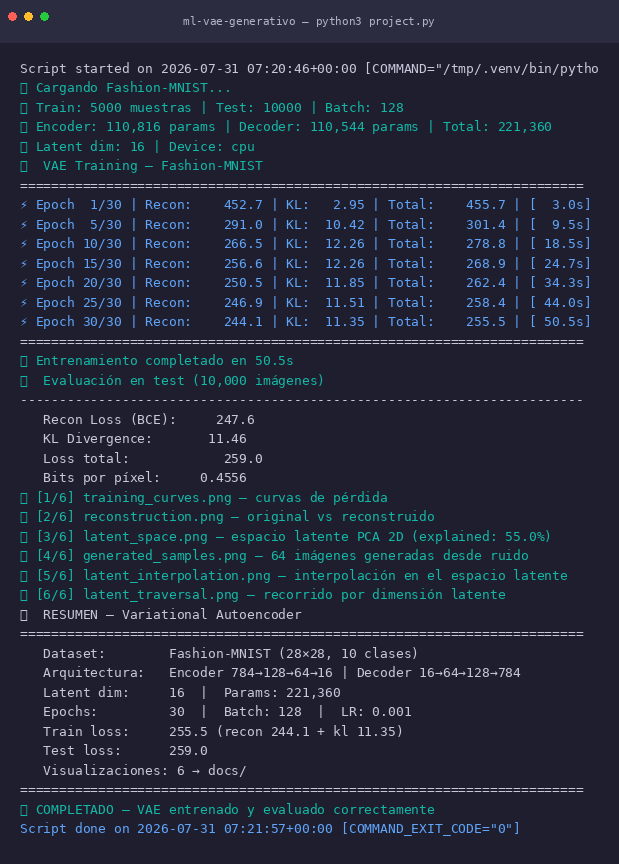
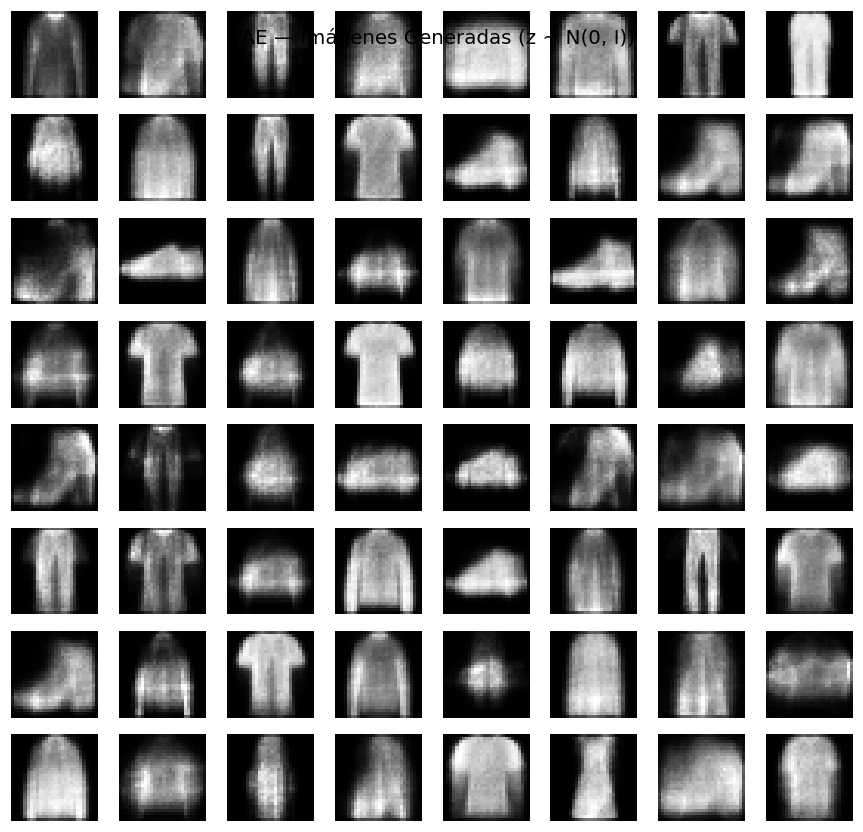
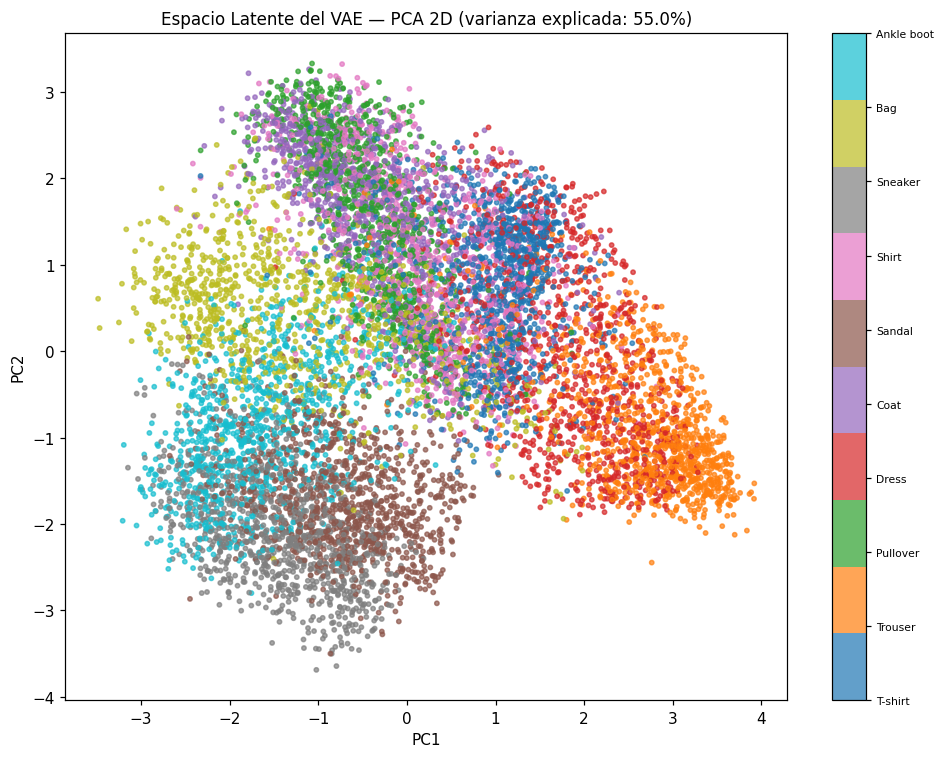
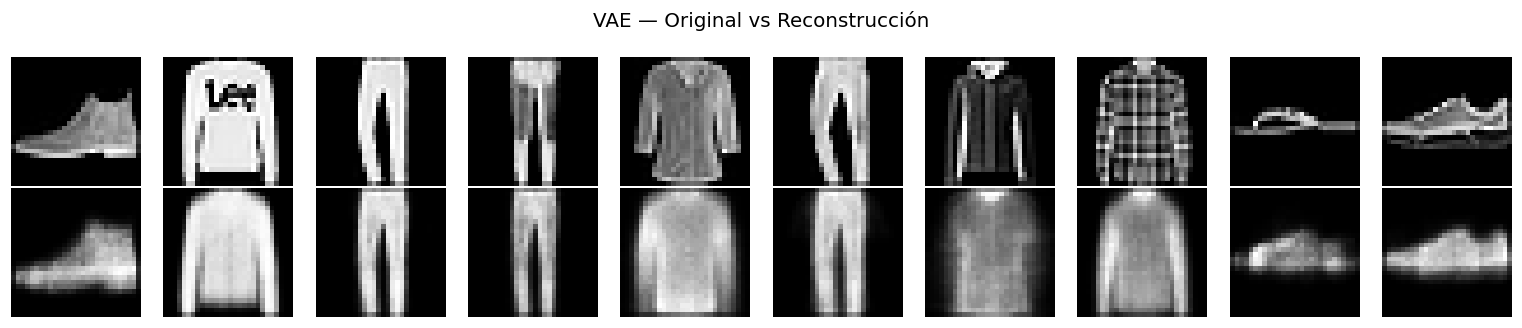
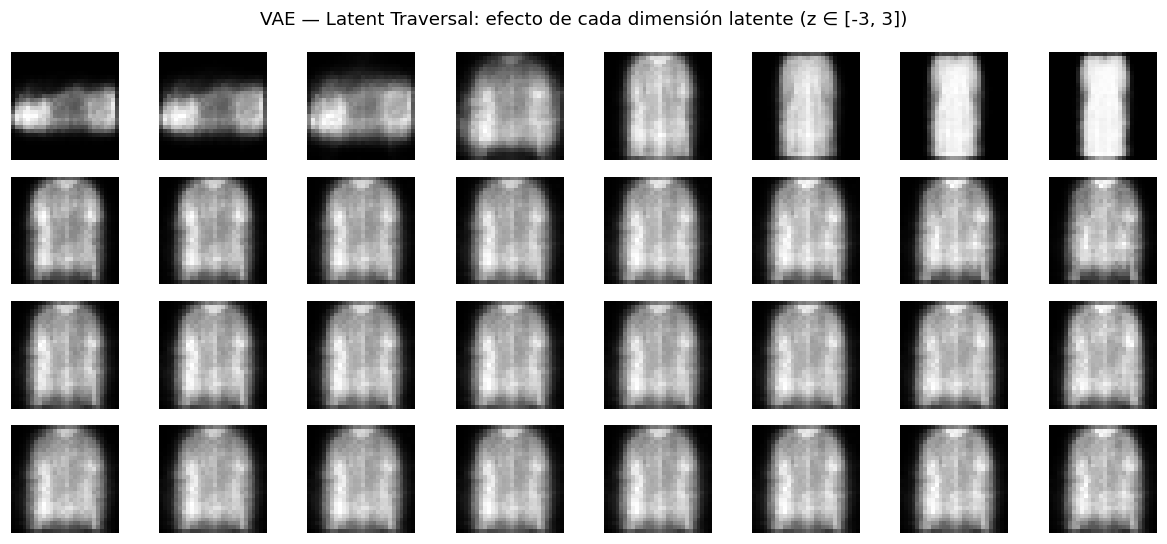
VAE (Variational Autoencoder) implemented from scratch in PyTorch on Fashion-MNIST. Unlike a classical autoencoder, the VAE learns a probability distribution in the latent space (mean mu and log-variance) and uses the reparameterization trick (z = mu + eps*sigma) to generate brand new images. Architecture: Encoder 784->128->64->16 (Linear + ReLU layers), Decoder 16->64->128->784 with Sigmoid, 221,360 total parameters. Loss = BCE (reconstruction) + KL divergence (regularizing the latent space toward N(0, I)). Trained for 30 epochs on 5,000 samples on CPU (50s). Test results: Recon Loss 247.6, KL 11.46, 0.456 bits/pixel, no overfitting (train 255.5 vs test 259.0). Findings: (1) the latent space organizes by class - the PCA 2D projection of the 10,000 test images shows clear semantic clusters (sneakers, trousers, bags); (2) latent interpolation between an ankle boot and a bag produces smooth, plausible transitions; (3) each latent dimension encodes a visual attribute (width, neckline shape); (4) reconstructions are faithful but smoothed, typical of VAEs. Includes 6 visualizations: training curves, original vs reconstructed, latent space PCA 2D colored by class (55% explained variance), 64 images generated from noise, latent interpolation and latent traversal.
# Key features
$ VAE from scratch in PyTorch: Encoder 784->128->64->16 and Decoder 16->64->128->784 (221,360 params)
$ Reparameterization trick (z = mu + eps*sigma) for backprop through sampling
$ Loss = BCE + KL: balance between reconstruction fidelity and regularized latent space
$ Generates new images by sampling z ~ N(0, I) and decoding
$ Continuous latent space: interpolation between garments with smooth transitions (morphing)
$ Latent traversal: analysis of which visual attribute each latent dimension encodes
$ PCA 2D projection of the latent space colored by class (55% explained variance)
$ CPU-optimized: 30 epochs on 5,000 samples in 50s, no overfitting (test 259.0)
# Gallery
# Technologies used